The Wisdom of the Stoop: Why America's Sidewalk Elders Are Among Our Most Vital Historians
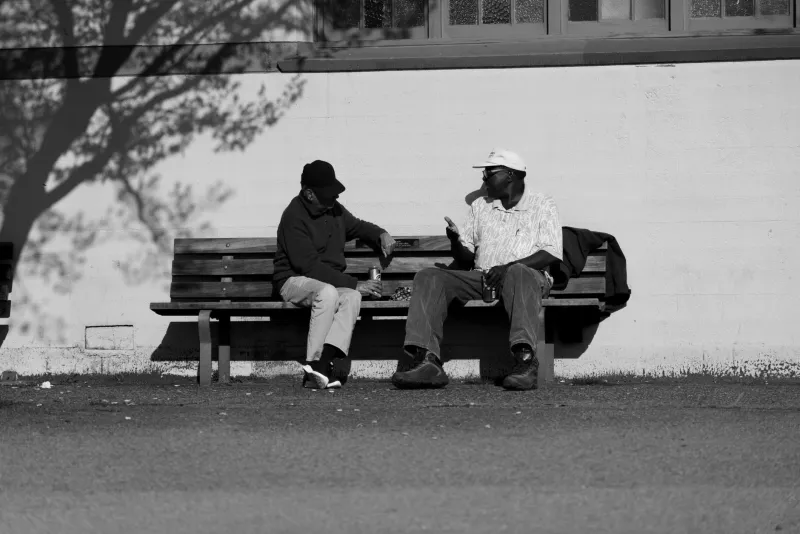
On a Tuesday afternoon in late September, three men occupy the same stretch of bench in Marcus Garvey Park in Harlem that they have occupied, with seasonal variation, for the better part of two decades. Their names are Cornelius, Raymond, and a man everyone calls Sticks, whose given name fewer and fewer people remember. They are discussing, in the particular unhurried way of people who have nowhere more important to be, a building that no longer exists.
The building stood on 122nd Street. It housed, at various points in its life, a numbers parlor, a beauty supply shop, a storefront church, and—briefly, legendarily—a rehearsal space used by musicians whose names are now in the history books. None of the three men can agree on the exact years. All three remember it differently. What they produce between them, across an hour of argument and laughter and digression, is something that no municipal record and no published history fully contains: the texture of a block as it was actually lived.
This is oral history in its most natural state. It is also, in the view of a growing number of community preservationists, among the most endangered forms of cultural documentation in America.
The Unstructured Archive
The academic field of oral history has existed, in formalized terms, since the mid-twentieth century. Its practitioners conduct recorded interviews, follow ethical protocols regarding consent and representation, and deposit their materials in institutional archives. The work is valuable and necessary. It is also, by its nature, selective: someone must decide who is worth interviewing, which questions to ask, and which answers to preserve.
What happens on park benches and front stoops operates by entirely different principles. It is self-selecting, digressive, contradictory, and shaped by the social dynamics of friendship and neighborhood loyalty rather than the agenda of a researcher. It is also, for precisely these reasons, extraordinarily rich. The stories that emerge in unstructured conversation are often the ones that would never surface in a formal interview: the ones that are embarrassing, or legally ambiguous, or simply too small and particular to seem worth mentioning to a stranger with a microphone.
Dr. Imani Watkins, a public historian based in Baltimore who has spent fifteen years studying informal knowledge transmission in urban communities, describes the sidewalk elder as "a living index." She argues that these individuals—disproportionately older, disproportionately long-term residents of neighborhoods that have experienced dramatic demographic and economic change—carry a form of neighborhood knowledge that is genuinely irreplaceable.
"When a longtime resident dies," she said, "you don't just lose a person. You lose a reference system. You lose the person who remembered what was there before the parking garage, who knew which family owned which building, who could tell you why the street name changed. That information doesn't exist anywhere else."
Portrait of a Neighborhood Narrator
In the Pilsen neighborhood of Chicago—historically a Mexican American community now navigating the pressures of gentrification—a woman named Dolores Vásquez has occupied the same folding chair on her front stoop every warm afternoon for more than thirty years. She is eighty-one. She has watched the neighborhood change from a distance of twelve feet, through the wrought-iron fence her late husband installed in 1987.
She knows which families left and why. She knows which murals were painted over and what they depicted. She knows the names of children who grew up on her block and where they went when the rents rose beyond what their parents could afford. She knows, because she attended the funeral, which local priest quietly advocated for undocumented parishioners during the immigration raids of the early 2000s. She knows the history of the community garden two blocks away, which was a vacant lot before it was a garden and a factory before it was a vacant lot.
None of this knowledge has been formally recorded. Vásquez has never been approached by a historian or an archivist. She has given no interviews. She simply sits, and talks, and remembers.
"People stop and ask me things," she said, when a neighbor who had heard about this article brought a reporter to meet her. "I tell them what I know. That's all."
The Effort to Capture What Is Slipping Away
A small but determined network of community organizations has begun working to bridge the gap between informal knowledge and formal preservation. Their approaches vary considerably, reflecting the different needs and resources of the communities they serve.
In Philadelphia, the Village of Arts and Humanities—a nonprofit organization rooted in the North Philadelphia neighborhood it has served since 1986—has launched a project it calls "Porch Histories," training young community members to conduct informal recorded conversations with longtime neighborhood elders in their own front-yard settings. The emphasis is on informality: participants are encouraged to let conversations wander, to follow tangents, and to resist the impulse to redirect toward predetermined topics. The resulting recordings are deposited with a local university archive and made available through the organization's community library.
In New Orleans, the Neighborhood Story Project has been doing related work since 2004, producing books and recordings that center the voices of residents in neighborhoods that are routinely described by outsiders but rarely given the opportunity to describe themselves. The organization's model explicitly rejects the extractive dynamic of conventional oral history, insisting that the communities whose stories are collected retain ownership of the materials produced.
In both cases, the organizations are grappling with a fundamental tension: how to capture what is valuable about informal storytelling without destroying the informality that makes it valuable in the first place. A recorder on the table changes what people say. An interviewer with a list of questions changes what people remember to mention. The challenge is to create conditions for honest, digressive, neighborhood-specific conversation—and then to preserve what emerges.
Why This Moment Is Urgent
The urgency of this work is not abstract. The generation of Americans who came of age before urban renewal, before the highway construction that bisected Black and Brown neighborhoods, before the waves of gentrification that have displaced working-class communities from city after city—that generation is dying. With them goes direct living memory of what American cities looked and felt and functioned like before the forces that reshaped them were set in motion.
At the same time, the public spaces where informal storytelling naturally occurs are themselves under pressure. Benches are removed from parks to discourage loitering. Stoops disappear as single-family homes are converted to rentals with no outdoor common space. The conditions that produce a Cornelius, a Raymond, and a man called Sticks—sharing a bench for twenty years, accumulating a shared archive of neighborhood memory—require a kind of stability and rootedness that is increasingly difficult to sustain.
Preserving informal oral history, then, is inseparable from the broader project of preserving the communities and public spaces within which it naturally arises. It is not enough to send researchers with recorders. The conditions for the conversation must themselves be protected.
Back in Marcus Garvey Park, the afternoon light is shifting. The three men are still talking. Nobody is writing anything down. The history continues, for now, to tell itself.