Letters from the Margins: The Volunteer Cartographers Charting America's Forgotten Paper Trail
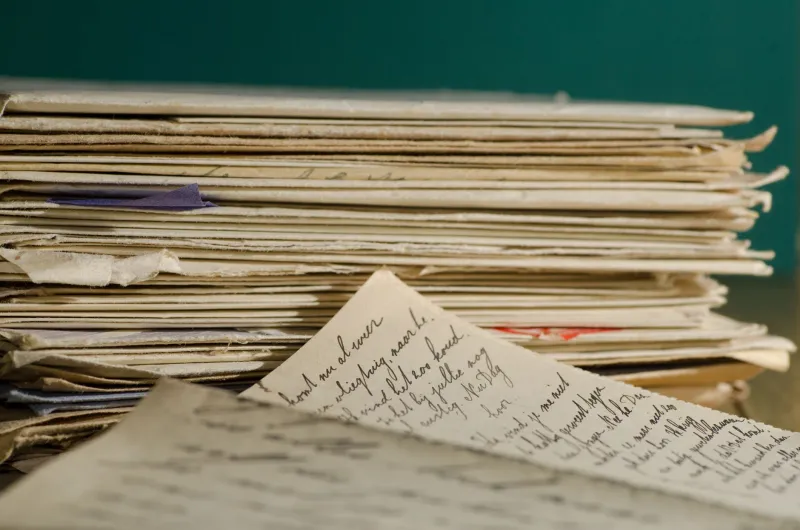
Somewhere in a suburb of Dayton, Ohio, a retired schoolteacher named Margaret Holloway spends her Tuesday evenings photographing letters. They arrived in a shoebox—purchased for eleven dollars at an estate sale—and they date from 1862 to 1865. The handwriting is cramped, the ink faded to a pale sepia, and the paper is so brittle that she turns each page wearing cotton gloves. She does not know yet whose family will discover these letters online and recognize their ancestor's name in the salutation. But she is certain someone will.
Holloway is part of a sprawling, largely invisible network of volunteer archivists who are quietly transforming how Americans engage with their own historical record. They haunt estate sales and antique markets, comb through the donations left at thrift stores, and respond to classified listings where families offer up boxes of "old papers" they cannot interpret and do not know how to preserve. What they find—and what they then digitize, transcribe, and catalog—represents a category of historical material that formal institutions have never had the resources, or sometimes the inclination, to collect.
The Gap That Volunteers Are Filling
American archival institutions hold an extraordinary breadth of material, but their collecting priorities have historically favored the prominent: politicians, industrialists, military officers, and literary figures. The correspondence of an Irish immigrant laborer in Pittsburgh, the diary of a Black schoolteacher in Reconstruction-era Georgia, or the business ledger of a Chinese merchant in 1890s San Francisco rarely found their way into university special collections or state historical societies. These records survived, when they survived at all, in the hands of families—and families, over generations, move, downsize, and lose track of what they hold.
The result is an enormous shadow archive, dispersed across the country in attics, storage units, and cardboard boxes. Much of it is deteriorating. Paper foxes, ink fades, and moisture is indiscriminate in its destruction. For every document that a volunteer archivist rescues, an unknown number disappear each year into landfills or recycling bins.
Grassroots digitization projects have emerged, in part, as a direct response to this erosion. Platforms such as the Smithsonian Transcription Center, WikiTree, and various state-level digital commons have created infrastructure through which volunteers can contribute scanned images and typed transcriptions to publicly accessible repositories. But many of the most consequential efforts operate outside these established frameworks, driven by individuals who build their own databases, maintain their own websites, and develop their own cataloging standards.
Methodology Born of Necessity
The practices these volunteers have developed are, by necessity, improvisational. Few have formal archival training. Most have taught themselves through online communities, YouTube tutorials, and trial and error. A scanning setup might consist of a consumer-grade flatbed scanner, a daylight lamp, and a homemade book cradle fashioned from foam. Metadata schemas are adapted from library science standards, modified to suit the particular demands of personal correspondence or handwritten account books.
What these archivists lack in institutional backing, they often compensate for in specificity of focus. Many have developed deep expertise in narrow geographic or thematic areas. One volunteer in rural Louisiana has spent seven years cataloging Creole family documents from the antebellum period. Another, based in Minneapolis, focuses exclusively on Scandinavian immigrant letters from the Upper Midwest, translating Swedish and Norwegian correspondence and cross-referencing names against census records to reconstruct family networks that might otherwise remain invisible to researchers.
This granular, sustained attention produces something that mass digitization projects—however well-resourced—rarely achieve: contextual depth. A letter means more when it is situated within a family's larger correspondence, cross-referenced with land records, and annotated with biographical notes about the sender and recipient. Volunteers who have spent years immersed in a particular community's documentary record often bring that context to their cataloging in ways that enrich the material immeasurably.
Institutional Partnerships and Their Complications
Formal archives and universities are increasingly recognizing the value of what these volunteers produce—and the relationships that have developed between institutions and grassroots archivists are, at their best, genuinely collaborative. Several state historical societies now maintain formal volunteer programs that provide participants with access to conservation resources and professional guidance in exchange for contributions to institutional collections. The Library of Congress has expanded its community cataloging initiatives, inviting public participation in the description and transcription of materials already held in its collections.
Yet the relationship is not without tension. Questions of ownership, attribution, and quality control surface regularly in volunteer communities. When a grassroots archivist has spent hundreds of hours building a database around materials they personally acquired and digitized, the question of whether and how an institution should incorporate that work—without absorbing or displacing the original effort—is genuinely complex. Some volunteers have experienced their contributions being folded into institutional platforms with minimal acknowledgment. Others have found that institutional standards, designed for professional workflows, are poorly suited to the realities of volunteer labor.
The most productive partnerships tend to be those in which institutions approach volunteers as genuine collaborators rather than as sources of free labor. Programs that offer volunteers training, archival supplies, and meaningful input into how their contributions are used have demonstrated far greater longevity and participant satisfaction than those that treat the relationship as purely extractive.
Who Gets to Be Remembered
Underlying all of this work is a question that Cultural Commons has explored from many angles: whose history gets preserved, and by whom? The volunteer archivists drawn to this work are often motivated by an acute awareness that the documentary record of ordinary American life—particularly the lives of working-class people, immigrants, and communities of color—has been systematically underrepresented in formal archives. They are, in many cases, attempting to correct that imbalance through the accumulation of individual acts of recovery.
The implications are significant. Primary sources are the foundation upon which historical understanding is built. When the available primary sources skew toward the powerful and the prominent, the histories that emerge from them will reflect those skews. Expanding access to documents that capture the texture of everyday life—the anxieties of a newly arrived immigrant, the domestic negotiations recorded in a household account book, the political observations of a rural farmer—does not merely add footnotes to existing narratives. It makes possible entirely different narratives.
For researchers, educators, and community members seeking to understand their own origins, the free online databases that these volunteers maintain are sometimes the only point of access. University library cards and research travel are not equally available to all. A database that anyone with an internet connection can search is a genuinely democratic resource in a way that a special collection with restricted access hours is not.
The Work Continues
Margaret Holloway expects to finish scanning the Dayton shoebox letters by spring. She will upload the images to the database she has maintained for nine years, transcribe as many as her eyesight and schedule permit, and tag each document with the names, dates, and locations she can identify. Then she will move on to the next acquisition.
She does not describe what she does as activism, though others might. She calls it, simply, paying attention—to the objects that carry other people's lives, to the obligation incurred by finding them, and to the possibility that somewhere, a family is searching for exactly what she has found. In that quiet attention, and in the tens of thousands of similar acts being performed across the country in spare bedrooms and at kitchen tables, a more complete version of the American past is slowly, painstakingly coming into view.