Music Without Marquees: The Living Room Orchestras Carrying Immigrant Classical Traditions Across America
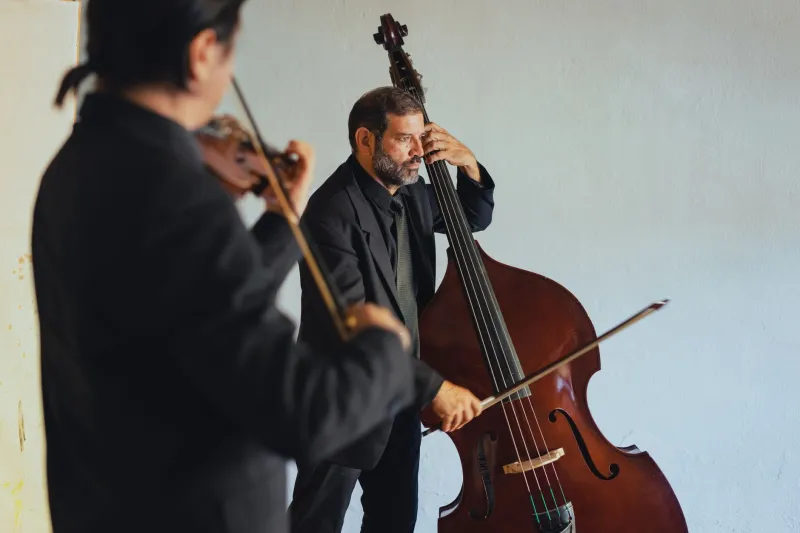
The rehearsal begins at seven-thirty on a Thursday evening in a ranch-style house in Dearborn, Michigan. Six musicians arrange themselves in a loose semicircle in the living room, their instrument cases stacked against the baseboards, their sheet music balanced on collapsible stands borrowed from a local school. The repertoire tonight includes compositions by Sayat-Nova, a celebrated eighteenth-century Armenian troubadour, alongside original pieces composed by the ensemble's youngest member, a twenty-three-year-old who arrived in the United States from Yerevan four years ago.
This is not a performance. There is no audience, no ticket revenue, no grant application pending. It is simply a group of people playing music they would otherwise have nowhere else to play.
"In Armenia, this music is everywhere," says Varduhi Petrosyan, the group's informal convener and a duduk player of considerable skill. "Here, nobody knows what a duduk is. So we play for each other, and for anyone who wants to listen."
The Invisible Concert Hall
Across the United States, scenes like this one repeat themselves in remarkable variety. In Chicago's Ukrainian Village neighborhood, a chamber ensemble of recent immigrants meets weekly to rehearse the works of Mykola Lysenko and other Ukrainian classical composers. In Houston, a community of Egyptian and Lebanese musicians sustains a thriving oud circle that draws participants from across the metropolitan area. In the Bay Area, Carnatic and Hindustani classical musicians gather in rotating home venues for performances that can last four hours or more, drawing audiences that travel significant distances for the privilege of attending.
These informal musical communities share several defining characteristics: they operate largely outside formal institutional structures, they are sustained by personal relationships rather than organizational infrastructure, and they remain almost entirely invisible to mainstream cultural coverage. The musicians who populate them are frequently trained to high levels of technical proficiency—many hold advanced degrees from conservatories in their countries of origin—yet they find little place for their traditions in the programming of American concert halls, which tend to privilege the Western European canon and its contemporary extensions.
The result is a parallel classical music ecosystem, rich and varied, that exists in the margins of American cultural life not because it lacks artistic seriousness but because the dominant institutions of American classical music have not made room for it.
Anchors in an Unfamiliar Landscape
For immigrant musicians, these informal ensembles serve functions that extend well beyond musical practice. They are, in the truest sense, cultural anchors—spaces where language, memory, and artistic tradition converge to create a sense of continuity amid the disorienting experience of displacement.
Nadia Kowalczyk, a violinist who emigrated from Kraków, Poland, to Cleveland, Ohio, in 2015, describes her chamber group as the first place she felt genuinely at home in the United States. "When you play this music, you are not an immigrant," she says. "You are just a musician, and the music is the same music it has always been. That matters more than I can explain."
Research in the sociology of migration has long documented the role of cultural practice in immigrant community formation, but the specific function of classical music in this context has received relatively little scholarly attention. The informal ensembles that sustain immigrant classical traditions operate differently from the ethnic social clubs and cultural festivals more commonly studied: they are smaller, more technically demanding, and more explicitly concerned with transmission across generations.
That intergenerational dimension is particularly significant. Many of these groups actively recruit younger participants, including second-generation immigrants who may have limited direct connection to their parents' countries of origin but who find in the music a form of cultural inheritance that feels both accessible and meaningful. In Dearborn, Varduhi Petrosyan teaches duduk to three teenagers whose families immigrated from Armenia before they were born. "The music is how they know who they are," she says simply.
Democratizing the Classical
Beyond their function as cultural preservation spaces, these informal ensembles are quietly challenging prevailing assumptions about who classical music is for and where it belongs. The Western classical tradition, as institutionalized in the United States, carries significant class and racial baggage: concert hall attendance remains heavily stratified by income and education, and the canon performed by major orchestras reflects a narrow slice of the world's classical musical heritage.
The living room orchestras and basement ensembles of the immigrant classical scene offer a countermodel. Admission is free. Participation is open. The music is rooted in communities rather than institutions. And the repertoire encompasses traditions—Ottoman makam, Balkan folk-influenced chamber music, Persian classical forms—that represent genuine classical sophistication entirely absent from the programs of most American concert halls.
Dr. Amara Osei-Bonsu, a musicologist at a midwestern university who has studied immigrant musical communities for the past decade, argues that these informal spaces are doing something that formal institutions have largely failed to accomplish. "They're making classical music a living community practice rather than a spectator experience," she says. "That's actually closer to how most of the world's classical traditions have always functioned."
Some of these informal communities have begun to attract institutional attention. A handful of immigrant chamber groups have received small grants from local arts councils or community foundations, and a few have been invited to perform at multicultural festivals or university events. The response within the communities themselves is mixed. Visibility brings resources and recognition, but it also brings the risk of being flattened into a cultural exhibit—performed for outside audiences in ways that strip the music of its communal, living character.
The Question of Continuity
The most pressing challenge facing these informal musical communities is not recognition but continuity. The first generation of immigrant musicians who established these ensembles is aging. Younger participants, while often enthusiastic, face competing demands on their time and attention. And the informal, relationship-based structures that make these groups so vital also make them fragile: when a key convener moves away or passes on, an entire musical community can dissolve.
Some groups are beginning to think more deliberately about institutional memory and succession planning—recording their repertoire, creating written documentation of their pedagogical methods, and establishing more formal mentorship relationships with younger musicians. Others resist formalization, fearing that the intimacy and spontaneity that define their practice will not survive the transition to institutional structure.
There is no easy resolution to this tension. What is clear is that these spaces—unglamorous, unsubsidized, and largely unnoticed—are doing work of genuine cultural significance. They are keeping alive musical traditions that would otherwise exist only in archives and academic monographs, sustaining them as living practices embedded in living communities.
In Dearborn, as the rehearsal winds down past ten o'clock, Varduhi Petrosyan sets down her duduk and accepts a glass of tea from her host. The music lingers in the room for a moment after the last note has sounded. Outside, the street is quiet. Inside, something ancient and irreplaceable has been, for another week, kept whole.