Screen Time as Sacred Time: How Digital Video Is Becoming a Lifeline for America's Endangered Folk Dances
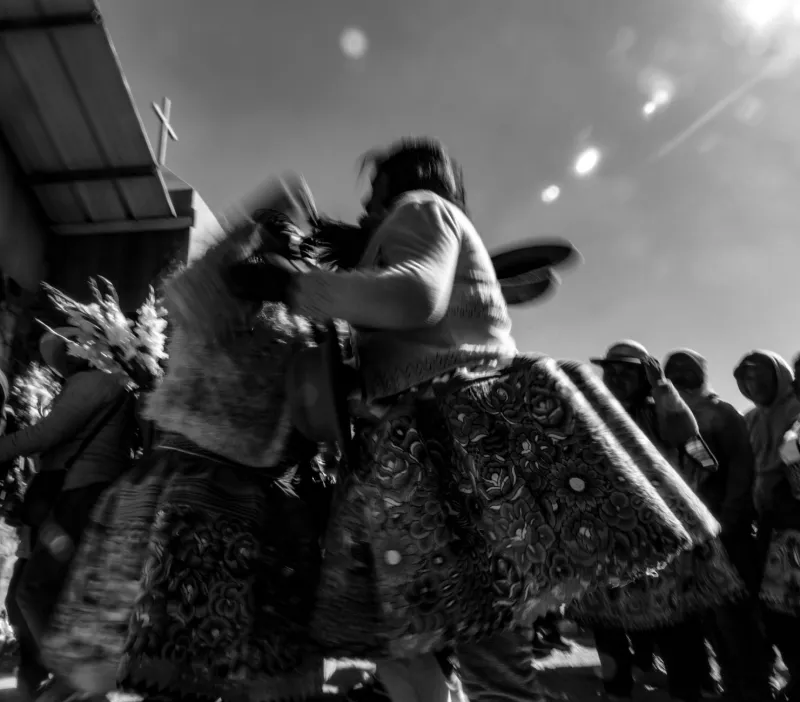
Betsy Combs learned to flatfoot in her grandmother's kitchen in Harlan County, Kentucky. The dance—a loose-kneed, percussive style of Appalachian step dance distinct from the more rigid clogging seen in competition circuits—was never taught in a studio. It was absorbed, the way most traditional movement is absorbed: by watching, by doing, by being corrected without ceremony, by the rhythm of a fiddle in a room where the dancing was never separate from the living.
When her grandmother died in 2019, Combs found herself in possession of something she could not fully name and was terrified to lose. She did what her generation does: she opened her phone and started filming herself.
The account she created on TikTok now has more than forty thousand followers. More significantly, it has become a hub for a scattered community of Appalachian flatfoot practitioners who found one another through comments, duets, and direct messages—people who, like Combs, had learned a tradition in isolation and assumed they might be among the last to carry it.
"I wasn't trying to go viral," she said. "I was trying to remember."
The Accidental Archive
What is happening across short-form and long-form video platforms with respect to traditional dance is not the product of any coordinated preservation initiative. It is emergent, uneven, and driven almost entirely by individuals who love what they do and fear that the world is not paying sufficient attention.
On TikTok, search terms like "traditional dance," "folk dance tutorial," and "cultural dance" return a striking range of content: Tejano two-step demonstrations from San Antonio living rooms, Hawaiian hula lessons taught by kumu hula who have moved their instruction online, Cherokee stomp dance discussions (though practitioners are careful to distinguish between what can be shared publicly and what remains ceremonially protected), Irish sean-nós step dancers performing on kitchen floors, and Filipino folk dance enthusiasts in diaspora communities across California and Illinois reconstructing regional styles from memory and archival photographs.
YouTube, with its longer format and more robust search infrastructure, has become host to a different category of preservation work. Dedicated channels have accumulated hours of footage: full performances filmed at community events, extended interviews with master practitioners, instructional series that attempt to transmit not just the steps but the cultural context surrounding them. The Vietnamese American community has used YouTube particularly effectively to document water puppetry demonstrations and folk performance traditions that younger generations in the diaspora might otherwise never encounter.
Taken together, this body of video content constitutes something genuinely new in the history of cultural preservation: a distributed, community-generated archive that exists outside institutional control, accessible to anyone with an internet connection, and growing in real time.
What the Camera Captures—and What It Cannot
The democratizing power of these platforms is real and should not be minimized. For communities whose traditions were systematically excluded from formal documentation—because they were poor, because they were not white, because their art forms were considered folk rather than fine—the ability to self-document and self-publish represents a meaningful shift in who controls the record.
But preservation scholars and dance ethnologists are careful to articulate what video cannot do. Movement traditions are embodied knowledge. They are transmitted through physical proximity, through the correction of a teacher's hand adjusting a student's posture, through the social context of a gathering where the dance is not performance but participation. A TikTok video can show you what a dance looks like. It cannot replicate the felt sense of doing it correctly, the musicality that comes from years of playing and dancing together, or the web of relationships within which traditional forms derive their meaning.
Dr. Angela Fonseca, a dance ethnologist at the University of Texas at Austin who studies digital preservation of Latinx folk forms, describes the phenomenon as "archival without being pedagogical." The videos create a record of what existed, she argues, but they do not reliably transmit the practice itself. "There's a difference between documentation and transmission," she said. "Both matter, but they're not the same thing, and we should be honest about which one we're primarily achieving."
There is also the question of platform stability. TikTok accounts can be deleted, suspended, or rendered inaccessible by policy changes. YouTube channels disappear when their creators stop paying for associated Google accounts. Unlike a film held in a climate-controlled archive or a notation system preserved in a library, digital content on commercial platforms is subject to the business decisions of private corporations. The communities doing this work have, for the most part, no backup.
The Organizations Trying to Bridge the Gap
A growing number of nonprofits and community organizations are attempting to formalize what individual creators have begun informally. The American Folklife Center at the Library of Congress has expanded its digital outreach, working with community partners to identify significant online collections and, where possible, ingest copies into more stable institutional repositories. Several state arts councils have begun funding "digital folk arts" documentation projects that pair experienced videographers with traditional dance communities.
In Lowell, Massachusetts—a city with significant Cambodian and Southeast Asian refugee populations—the Mekong River Dance Collective has partnered with a local community media organization to create a dual archive: a publicly accessible YouTube channel for community engagement and a separately maintained hard-drive archive deposited with a regional university library. The model, while resource-intensive, represents a more durable approach to the tension between accessibility and longevity.
What these efforts share is an understanding that the platforms themselves are not the archive. They are the interface. The archive must be built elsewhere, with greater intentionality and institutional commitment.
The Dancer as Historian
Perhaps the most significant contribution of the digital folk dance movement is the least quantifiable: it has given practitioners themselves the tools to assert the historical importance of what they carry. When Betsy Combs films herself flatfooting and explains, in the caption, that this style of dance predates the commercialized clogging competitions that most people associate with Appalachian dance, she is not just sharing a video. She is making an argument about what deserves to be remembered and who gets to say so.
That argument, made millions of times across thousands of accounts by people who were never trained as historians or archivists, is quietly reshaping the landscape of American cultural memory. It is imperfect, incomplete, and vulnerable to the whims of algorithms and corporate policy. It is also, for many traditions, the most robust documentation effort currently underway.
The dance is not saved. But it is being seen. And for now, that is not nothing.