Walls That Witness: How Community Muralists Are Rewriting Urban History in Plain Sight
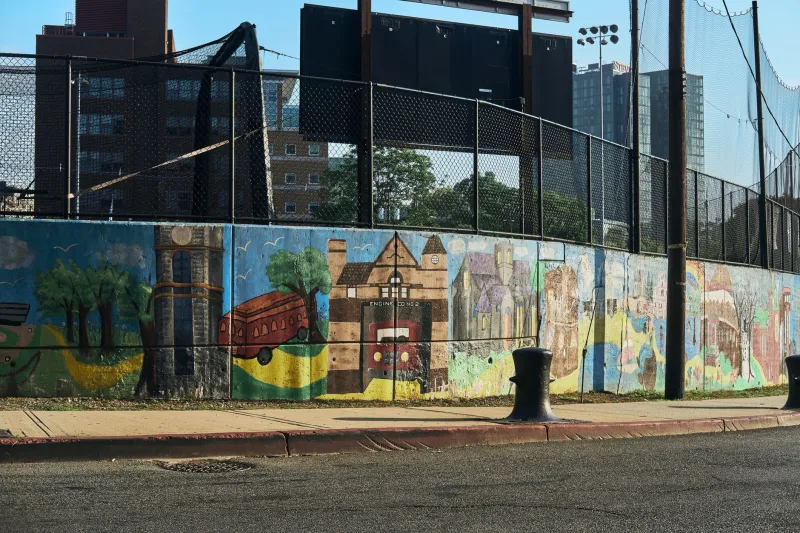
In the shadow of a shuttered laundromat on the east side of Cleveland, a woman named Esperanza Reyes spent eleven consecutive weekends on a scaffold, painting the face of a labor organizer most of her neighbors had never heard of. The organizer, a Black steelworker named Clarence Tatum, had led a wildcat strike in 1952 that briefly halted production at a mill that has since been demolished. No plaque marks the site. No school curriculum mentions his name. But now, on a wall visible from three intersections, his likeness presides over a corner that residents had long associated with vacancy and neglect.
"People stopped their cars the first week," Reyes said. "They got out and read the text. That doesn't happen. People don't stop for anything on that block."
Reyes is one of hundreds of artists across the country participating in what has become a quietly radical form of cultural preservation — one conducted not in archives or academic journals, but in aerosol and latex, on surfaces that landlords, municipal governments, and community organizations have agreed, sometimes reluctantly, to surrender to public memory.
The Canvas Nobody Wanted
Blighted urban infrastructure — the blank facades of abandoned storefronts, the windowless sides of parking garages, the plywood panels boarding up foreclosed properties — has long been regarded as an eyesore problem awaiting a real estate solution. What community muralists have recognized, often intuitively, is that these surfaces represent something else entirely: unclaimed public space in cities where such space is increasingly rare.
The movement draws on a long tradition. The muralist projects of the New Deal era, the Chicano mural renaissance of East Los Angeles in the 1970s, and the public art initiatives that followed the urban renewal devastation of the 1980s all established the wall as a legitimate medium for community storytelling. What distinguishes the current moment is scale, coordination, and an explicit framing of mural work as archival practice.
Organizations such as Mural Arts Philadelphia, Groundwork Denver, and the Chicago Mural Group have developed formal methodologies for community engagement — conducting oral history interviews, partnering with local historians, and submitting proposals to neighborhood councils before a single sketch is drawn. The mural, in this framework, is the endpoint of a research process, not merely an aesthetic intervention.
"We treat every wall like a primary source document," said Marcus Webb, program director at a community arts nonprofit in Memphis that has completed more than sixty murals in the past eight years. "The painting is the publication, but the work that precedes it is the scholarship."
Permission, Power, and the Politics of the Wall
The question of who controls public surfaces is rarely simple. In most American cities, exterior walls belong to property owners, meaning that muralists must secure permission from private individuals or corporate entities whose interests may diverge sharply from those of the surrounding community. A landlord who has allowed a building to deteriorate for a decade may nonetheless object to an image that documents that deterioration — or that memorializes the community that existed before his ownership.
In Detroit, muralist collective Reclaim the Block encountered precisely this friction when it attempted to paint a tribute to residents displaced by a wave of tax foreclosures between 2008 and 2015. Several property owners along their proposed corridor declined to participate. The collective ultimately worked around the refusals, creating a fragmented installation across willing surfaces that, by its very discontinuity, illustrated the scattershot nature of displacement itself.
"The gaps in the mural became part of the story," said collective member Dara Okonkwo. "Every blank wall where we couldn't get permission is a wall that belongs to someone who doesn't feel accountable to this community."
Municipal governments present a different set of complications. Some cities have embraced mural programs as economic development tools, channeling public art funds toward tourist corridors and gentrifying neighborhoods while community-led projects in lower-income areas struggle for basic permitting. Critics within the muralist community argue that institutionalized mural programs can inadvertently reproduce the same hierarchies of visibility that grassroots artists are trying to disrupt.
"When the city decides which stories get told, that's not preservation — that's curation in someone else's interest," said San Antonio-based artist and activist Leticia Garza, whose work has focused on documenting the Tejano labor history of the city's near west side.
Temporary Installations, Permanent Memory
Perhaps the most counterintuitive aspect of mural-based cultural preservation is the medium's inherent impermanence. Paint fades. Buildings are sold, demolished, or redeveloped. A mural that survives for a decade is, by the standards of the form, a long-lived artifact. Many disappear within months.
And yet practitioners consistently report that even short-lived installations generate lasting effects on community memory. Photographs circulate on social media. Oral accounts multiply. Younger residents who witnessed a mural's creation carry the story forward in ways that no formal archive fully replicates.
In Baltimore, the nonprofit Living Walls Project has responded to this impermanence by building a digital archive of every mural it has commissioned or documented since 2009 — including high-resolution images, audio recordings of community conversations that shaped the imagery, and written histories of the subjects depicted. When a mural is painted over or lost to demolition, the archive preserves not just the image but the social process that produced it.
"We don't think of the wall as the final product anymore," said Living Walls archivist Priya Subramaniam. "The wall is a moment in a longer conversation. Our job is to make sure that conversation doesn't end when the paint does."
Who Gets Painted, and Who Decides
Beneath the logistical challenges of funding and permitting lies a more fundamental question: whose history is worth preserving, and who is authorized to make that determination? Community muralism, at its most principled, attempts to answer by distributing both the research and the decision-making to the communities themselves. In practice, this ideal is unevenly realized.
Artists who are not themselves members of the communities they depict face particular scrutiny — and, advocates argue, deserve it. The history of public art is replete with well-intentioned outsiders whose representations, however technically accomplished, have flattened or exoticized the communities they sought to honor. An increasing number of mural programs now require that lead artists have demonstrated ties to the neighborhoods in which they work, or that they collaborate substantively with community members throughout the design process.
"The best mural I ever painted was one where I was essentially the hands," said Reyes, reflecting on a project in which a community council of elders and young residents co-designed every element of the composition. "My job was to execute their vision with skill. That was enough. That was more than enough."
A Commons Built on Brick and Mortar
The muralists working across American cities today are engaged in something that resists easy categorization. They are artists, certainly, but also archivists, community organizers, and historians working in a medium that reaches audiences no library or lecture hall ever could. Their galleries are accessible to anyone who walks, drives, or rides a bus past the walls they have transformed.
In a cultural landscape increasingly defined by paywalls, institutional gatekeeping, and the privatization of public space, there is something genuinely radical about history that simply exists — open, visible, and free — on the side of a building.
For Esperanza Reyes, standing beneath Clarence Tatum's painted gaze on a cold November afternoon, the significance of the work is immediate and personal. "This neighborhood has been told its history doesn't matter," she said. "Every time someone reads that wall, we're telling them something different."
The wall, for now, stands.